Captain Hardiman
Chasing SunlightCaptain Hardiman is a deceased airship captain whose memory shadows the Endeavor’s expedition from its preparations in Beacon to Jonathan Heights’s final approach to Bright Defile. He is significant not because the narrative presents an extended biography of him, but because his absence becomes a measure of loyalty, responsibility, and the danger of pursuing knowledge beyond human limits.
Identity and Reputation
Captain Hardiman was an experienced airman and a friend of Jonathan Heights. His defining practical trait was an unwillingness to surrender control of a vehicle: he was uncomfortable as a passenger and preferred to walk rather than allow someone else to operate an aircraft or other conveyance. The recollection is made while Jonathan and Captain Montgomery are being driven through the Industrial Quarter, where Montgomery’s own discomfort as a passenger recalls Hardiman’s stronger aversion. The comparison makes Hardiman’s absence immediate: he is not merely a name from an earlier expedition, but the standard against which the living captain’s unease is measured.
Jonathan’s memory of Hardiman is affectionate but restrained. He notices the beginning of a smile at Montgomery’s discomfort, yet cannot sustain the humor because Hardiman “hadn’t made it back.” His death therefore interrupts an otherwise ordinary recollection, turning a familiar habit into evidence of loss. The line also establishes that Hardiman belonged to Jonathan’s personal circle rather than being only a professional associate.
Connection to the Endeavor and the Failed Expedition
Hardiman’s death is bound to the history of the Endeavor. After the ship is damaged and later prepared for another voyage, Captain Montgomery describes her as a “wonderful old girl” who deserved repair rather than scrapping, despite the trouble caused by His Majesty at Gillar’s Folly. His defense of the vessel is inseparable from the memory of what it and its crew have endured, including Hardiman’s absence and the expedition’s disastrous consequences.
The earlier failure also shapes Eleanor McAvey’s distrust of Jonathan. When Jonathan invites her to join another expedition, she accuses him of having left her to die as he had left Stoneface and Hardiman. Jonathan rejects the accusation with unusual violence, insisting that he abandoned nobody and betrayed nobody, and arguing that the expedition members had simply been unequal to what they discovered. His response reveals how central Hardiman’s death is to the dispute: Jonathan treats any suggestion that he failed his companions as an attack on his honor, while Eleanor treats the same history as proof that his ambition has already cost lives.
Hardiman’s widow later becomes part of the opposition to the new expedition. Eleanor explains that the shipyard discovered additional sabotage aboard the Endeavor and dealt with the worker responsible, but that the worker had been paid by Hardiman’s widow. Jonathan immediately understands why she might resent him: he is the sole survivor of the previous disaster and is chartering another expedition as though nothing had happened. This does not establish the widow’s full motives, but it makes Hardiman’s death an active political and emotional force rather than a settled matter of the past. The refitted ship carries not only repaired machinery but also unresolved grievance.
Death, Survivorship, and Memorial
The narrative repeatedly places Hardiman among those whose deaths cannot be undone by ceremony. During the later funeral service for three dead crew members aboard the Endeavor, Antomine conducts rites for men recovered from the ruins of Danner’s Grasp; George’s casket is empty, and nobody proposes searching for his body in the corrupted settlement. The ritual’s combination of formal words, sealed caskets, and bodies rendered into dust recalls the broader expeditionary practice of making meaning after people have been lost in places where recovery is impossible.
Hardiman himself receives no comparable on-page funeral. His absence is instead preserved through recollection, accusation, and the final landscape of Bright Defile. When Jonathan warns the expedition members that most of them have reached their limit in the sunlight, he names Captain Hardiman and Stoneface as examples of what happens when a person goes farther than their capacity allows. Their deaths become cautionary evidence: the light does not merely block the unprepared; it exposes failures and can destroy those who refuse to turn back.
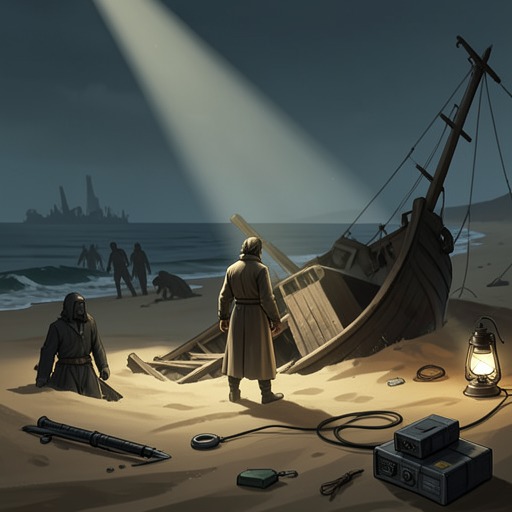
At the threshold of Bright Defile, Jonathan comes upon salt statues bearing the likenesses of Captain Hardiman and Stoneface. Their expressions of determination and fascination have been fixed permanently in salt. Jonathan cannot explain why they continued forward or what drove them beyond their abilities, but he recognizes that they were neither the first nor likely to be the last victims. Their statues transform their deaths into a visible historical record of overreaching. The explorers who follow are forced to approach the same warning in physical form before deciding whether to retreat.
Influence on Jonathan Heights
Hardiman’s memory is one element in Jonathan’s long process of severing himself from his former life. At the final barrier before sunlight, Jonathan sacrifices his estate, his connections to his chauffeur and housekeeper, his books, the friendship of Eleanor, and his banishment from Ukaresh. He also recalls the death of Tiuni, the destruction of Tor Ilek, the sacrifice of Angkor Leng, his rejection of the Players and the Game, and the loss represented by Hardiman and Stoneface. Hardiman’s place in this inventory is distinctive: he is not simply another casualty, but part of the moral history that Jonathan must carry before he can cross.
The final crossing makes the cost concrete. Jonathan lays down his cane as the last sacrifice, crosses the gap, and enters Bright Defile, where the sun reveals the truths of the world without the protective ambiguity of darkness. Hardiman’s statue remains behind as a warning and a testament. Jonathan’s progress does not redeem Hardiman’s death, nor does the text claim that Hardiman’s failure was meaningless; instead, the dead captain marks the boundary between knowledge pursued with human limits and knowledge purchased through the destruction of those limits.
Narrative Role and Significance
Captain Hardiman functions as a recalled character whose importance grows through absence. He appears in the living characters’ memories, in the practical history of the Endeavor, in the hostility surrounding the refit, and finally as a salt figure at the entrance to the sunlit world. Each recurrence changes the emphasis. First he is a familiar friend with a recognizable dislike of being a passenger; then he is a lost captain whose death complicates Jonathan’s honor; then he is the reason a widow may seek retaliation; finally he is an explorer permanently preserved at the point where curiosity became fatal.
His characterization also sharpens the contrast between Captain Montgomery and Jonathan. Montgomery mourns the ship and recognizes the emotional value of the old vessel, while Jonathan responds to the expedition’s losses by seeking better preparation and greater knowledge. Hardiman’s preference for control, his failure to return, and his statue at the final threshold together expose the limits of mastery. The captain could refuse to be carried by another driver, but no human will can simply command the forces encountered beyond the map.
In this sense, Captain Hardiman embodies the book’s recurring tension between expeditionary competence and existential risk. The living can repair an airship, refine its engines, arm it against attack, and conduct proper rites for the dead, yet none of those measures guarantees survival before the deeper revelations of Bright Defile. Hardiman’s memory remains valuable precisely because it resists easy closure: he is remembered with affection, defended as a friend, blamed by those who survived, and preserved as a warning to anyone who mistakes determination for readiness.